Less pollution
Particulate matter — from smoke, traffic, and indoor sources like mold — reaches deep into the lungs. Filtration, ventilation, and positive pressure all impact these levels.


Why clean air · Definitions
Less pollution, fewer airborne germs, and a simple yardstick for both. Here is how clean indoor air is defined, how it is achieved, and what it looks like in a classroom.
Particulate matter — from smoke, traffic, and indoor sources like mold — reaches deep into the lungs. Filtration, ventilation, and positive pressure all impact these levels.
Colds, flu, and other viruses spread through shared air. Filtration, ventilation, and UV air quality interventions lower virus-carrying particles in the room.
Air changes per hour (ACH) show how often a room’s air is replaced with clean air. Many classrooms get 0.5–1; interventions can add five or more.
The standard
No federal standard governs the air inside schools or child care buildings. A written local standard gives everyone the same target, for both the equipment and the air.
| What the standard covers | Recommended target |
|---|---|
| Delivered clean air | 750 to 1,500 CFM per classroom, counting HVAC and in-room cleaners together. Consistent with ASHRAE Standard 241 for a typical classroom; about five air changes per hour in a 9,000 cubic foot room. |
| Noise | Under 45 dBA with every unit in the room running at its operating setting |
| Filtration | MERV-13 minimum |
| Indoor PM2.5 | At or below the WHO guideline: 15 µg/m³ over 24 hours, 5 µg/m³ annual average |
| Ventilation | A CO2 action level (commonly around 1,000 ppm) that triggers a ventilation check |
| Excluded technologies | No ionizing, plasma, or ozone-generating air cleaners |
Noise belongs in the standard. Loud units were the most common reason pandemic-era air cleaners failed: teachers turned them down or off.
The tools
Most buildings need a combination of tools. Filtration is often the strongest first step because it handles particles and germs at once and works without new HVAC.
| Tool | Fine particles | Airborne germs | CO2 and gases | Smoke days | Keep in mind |
|---|---|---|---|---|---|
| Filtration | Strong effect | Strong effect | Little or none | Strong effect | Filters need changing on schedule |
| Ventilation | Partial | Strong effect | Strong effect | Little or none | Costs energy; can bring smoke in |
| Positive pressure | Partial | Little or none | Little or none | Strong effect | Needs working HVAC, sealed building |
| UV air treatment | Little or none | Strong effect | Little or none | Little or none | Germs only; needs safety testing |
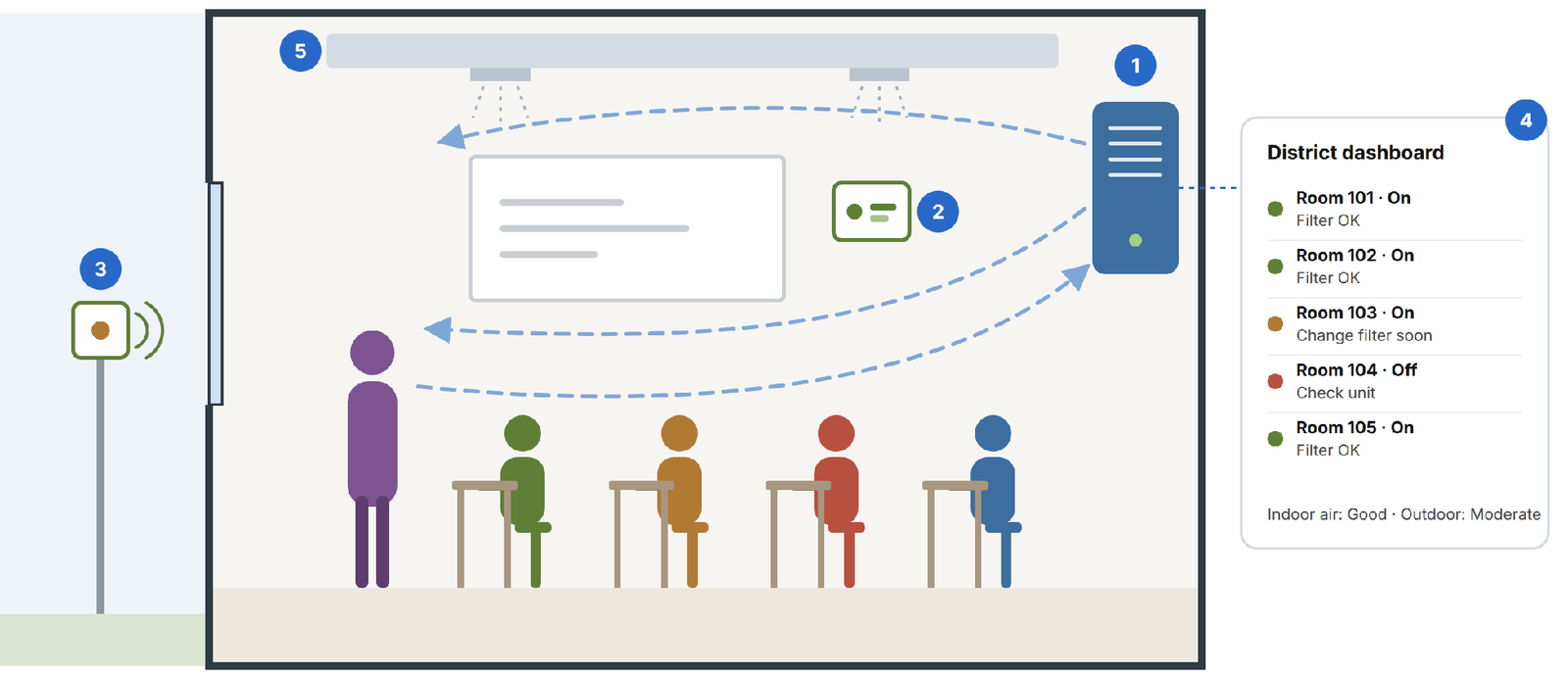
In practice
The field
Its School Air Quality Fellowship helps 50 district staff a year write indoor air policies, and it co-developed with us the Model RFP and performance criteria for classroom air cleaners.
Co-founded by Dr. Georgia Lagoudas and Bronwyn King, Air Club builds the global movement for healthy indoor air, including a pledge launched at the United Nations in 2025.
Its Clean Air School Challenge offers schools up to $30,000 for indoor air quality work, in collaboration with the Center for Green Schools fellowship.
Randomized trials, natural experiments, and cohort studies — including the inconvenient findings.
Research libraryA small national cohort of cities aiming for cleaner classroom air by fall 2027.
Join the cohortWhether you lead a city or a district, fund this work, or want it for your own school.
Get in touch